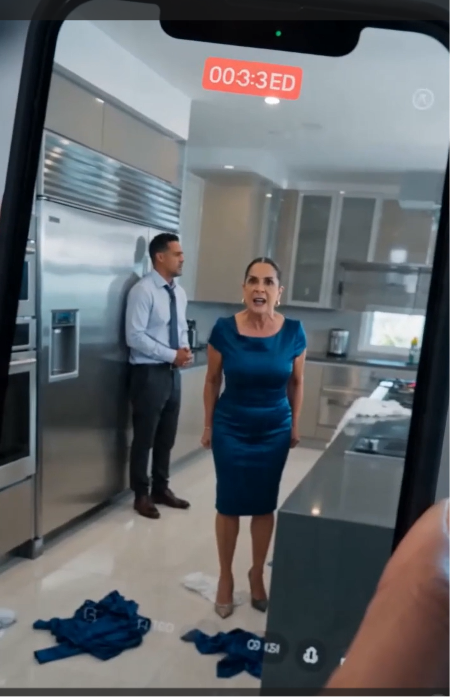
My mother-in-law tore my dress to humiliate me in my own kitchen; the next day, her son lost his job, the house, and the keys.
Valentina Reyes built Ruta Norte Logistics from a single rented office in Querétaro, back when she still counted every peso before spending it.
She was twenty-four then, fresh out of business school, armed with a small loan from her grandmother and an idea nobody else believed in yet.
Transportation and distribution for small businesses who couldn't afford the major carriers.
She started with three trucks and a spreadsheet she updated by hand every single night.
Within five years, Ruta Norte had grown into a regional operation, contracts with local pharmacies, small supermarket chains desperate for reliable delivery.
By year eight, national contracts followed, major supermarket partnerships, pharmaceutical distribution deals that transformed her small startup into something considerably larger.
Valentina remembered every difficult year clearly, the sleepless nights, the loans she barely qualified for, the moments she nearly gave up entirely.
Nobody handed her anything.
She remembered one particularly difficult winter, three years into the business, when a major client nearly canceled their contract over a missed delivery deadline.
She'd driven the shipment herself overnight, arriving exhausted but successful, saving the account through sheer stubborn determination rather than any resources beyond her own willingness to work harder than anyone expected.
That moment, more than any other, taught her exactly what building something from nothing actually required.
She built Ruta Norte with her own hands, her own sacrifice, her own relentless determination.
She met Alejandro during year six, at an industry conference in Mexico City, where he worked as a junior analyst for a competing logistics firm.
He was charming immediately, attentive in ways that felt genuine rather than calculated, at least during those early months of courtship.
He'd asked thoughtful questions about her business during their first conversation, seeming genuinely impressed rather than intimidated by her obvious success.
Looking back, Valentina sometimes wondered whether that early attentiveness reflected genuine interest or simply an early awareness of the opportunity her success represented.
They married two years later, a modest ceremony given how much of Valentina's resources remained tied up in the company's continued growth.
Alejandro joined Ruta Norte shortly after their wedding, starting in a mid-level operations role before eventually advancing to regional director, a position Valentina had personally advocated for despite some hesitation among her existing management team.
"Are you sure hiring your husband into leadership is wise?" her CFO, Ricardo, had asked carefully during that transition period.
"He's earned it," Valentina insisted at the time, genuinely believing her own assessment despite the obvious potential conflict of interest.
Looking back now, she understood her judgment during those early years had been clouded by love, by the desire to build something shared rather than something she alone controlled.
She remembered specific board meetings where she'd deferred to Alejandro's opinions even when her own instincts suggested otherwise, wanting desperately to demonstrate genuine partnership rather than simple ownership.
Ricardo had noticed this pattern too, occasionally offering gentle observations that Valentina hadn't fully absorbed until much later.
"You built this company trusting your own judgment," he mentioned once. "Don't lose that instinct now that you're married."
She'd dismissed the comment lightly at the time, though she thought about it often in the years following her divorce.
Alejandro performed adequately in his regional director role, competent enough, though Valentina increasingly noticed he leaned heavily on her guidance for major decisions rather than developing independent leadership instincts of his own.
She told herself this was simply deference, respect for her greater experience within the company she'd personally built.
She didn't yet understand how deeply that dynamic would eventually poison their entire relationship.
Teresa, Alejandro's mother, entered Valentina's life with immediate, unmistakable coldness.
From their very first meeting, months before the wedding, Teresa made her disapproval evident through small, calculated cruelties disguised as innocent observations.
"You're older than most brides," she commented during that initial dinner, glancing pointedly at Valentina's simple, unadorned outfit. "I suppose career women often marry later."
Valentina had brushed off the comment at the time, attributing it to nervousness, cultural differences, the general awkwardness of meeting a future mother-in-law for the first time.
She remembered mentioning the comment to a close friend afterward, laughing it off as simply an awkward first impression rather than any genuine warning sign worth taking seriously.
"Some mothers just struggle letting go of their sons," her friend had reassured her. "It usually improves once she gets to know you better."
It never improved.
The comments continued throughout their engagement, small barbs about Valentina's demanding career, pointed questions about when grandchildren might arrive, subtle implications that Valentina's success somehow diminished rather than complemented her role as a future wife.
"A woman shouldn't be too busy to properly care for her husband," Teresa remarked once, during a family dinner Valentina had rushed to attend directly from a critical board meeting.
Alejandro rarely defended her during these exchanges, typically offering only mild, ineffective deflections before allowing his mother's comments to simply fade into uncomfortable silence.
Valentina noticed this pattern early, though she consistently rationalized it, telling herself Alejandro simply struggled with confrontation, that his passivity reflected cultural respect for maternal authority rather than genuine agreement with his mother's criticisms.
She married him anyway, believing love and partnership would eventually smooth over whatever tension existed between herself and Teresa.
The house in Lomas de Chapultepec, purchased three years before their wedding using proceeds from Ruta Norte's most successful expansion year, remained entirely in Valentina's name throughout their entire marriage.
She'd never considered adding Alejandro to the deed, not out of distrust exactly, but simply because the purchase predated their relationship entirely, a personal accomplishment she'd achieved independently before he ever entered her life.
Alejandro never pushed for co-ownership, though Teresa periodically raised the topic during family gatherings, always framed as simple practical concern rather than obvious self-interest.
"Married couples should share everything equally," Teresa remarked once, shortly after the wedding. "It's strange, keeping such significant assets separate."
Valentina had explained, patiently at first, that the house predated their marriage, that Mexican law regarding separate property protected assets acquired before marriage regardless of subsequent circumstances.
Teresa never seemed satisfied by that explanation, continuing to raise the topic periodically throughout their marriage, as though sheer persistence might eventually alter established legal and financial reality.
She'd bring it up at the strangest moments, once during a birthday dinner, another time during what was supposed to be a casual holiday visit, each attempt carefully disguised as innocent family concern rather than the calculated pressure it actually represented.
Alejandro rarely intervened during these conversations, typically changing the subject rather than directly addressing his mother's persistent, inappropriate interest in Valentina's separately owned property.
The years passed with this underlying tension simmering beneath otherwise ordinary domestic life.
Valentina continued expanding Ruta Norte, securing increasingly significant contracts, building a company now employing over three hundred people across multiple regional distribution centers.
Alejandro remained regional director, competent but never particularly ambitious about advancing further within the company hierarchy.
Teresa's comments grew slightly bolder over time, emboldened perhaps by years of Alejandro's consistent failure to establish meaningful boundaries regarding her behavior toward his wife.
That particular Tuesday evening began with nothing suggesting the devastating confrontation ahead.
Valentina had returned home early, exhausted but satisfied after finalizing a significant new contract with a national pharmacy chain, one that would substantially expand Ruta Norte's market presence throughout central Mexico.
She'd laid out her white dress carefully on the kitchen island, planning her outfit for an important dinner scheduled the following evening with business partners visiting from Santa Fe.
The dress had cost considerably more than she typically spent on clothing, though the investment felt justified given the significance of the meeting ahead.
Teresa arrived unannounced around seven, letting herself in using the spare key Alejandro had given her years earlier despite Valentina's periodic, gentle suggestions that such unrestricted access felt inappropriate given ordinary boundaries most families maintained.
"I need to speak with my son," Teresa announced upon entering, barely acknowledging Valentina's presence in the kitchen.
Alejandro emerged from his home office, tie already loosened after a long day, greeting his mother with the familiar deference Valentina had witnessed countless times throughout their marriage.
"Mom, what brings you by?" he asked.
"Your sister needs help," Teresa said, settling into a kitchen chair without invitation. "Financial help. I've been thinking about how we might arrange things."
Valentina, still moving around the kitchen preparing a simple dinner, listened with growing unease as Teresa outlined an elaborate proposal involving significant financial support for Alejandro's younger sister, currently navigating yet another failed business venture.
Brielle had attempted real estate, then event planning, then most recently an artisanal candle business Teresa herself had helped fund twice already without any meaningful return on that investment.
Valentina had watched this pattern repeat itself for years, quietly frustrated but never directly involved given her deliberate boundary regarding family financial matters unrelated to her own household.
"The house here in Lomas is worth considerably more than what you two actually need," Teresa continued, gesturing broadly around the kitchen. "Perhaps it's time to consider selling, using some of that value to help family who actually need support."
Valentina set down the knife she'd been using, turning fully toward her mother-in-law.
"This house isn't for sale," she said calmly. "And it's not really a conversation for tonight."
Teresa's expression hardened instantly.
"I wasn't speaking to you," she said sharply. "I was discussing family matters with my son."
"I am family," Valentina said, maintaining her composure despite the obvious provocation. "And this happens to be my house."
That single sentence apparently proved too much for Teresa's carefully maintained restraint.
She rose from her chair abruptly, moving toward the kitchen island where Valentina's white dress lay carefully arranged for the following day's important dinner.
"Your house," Teresa repeated, voice dripping with contempt. "Everything in this house is paid for by my son."
Before Valentina could respond, Teresa grabbed the delicate fabric with both hands.
The tearing sound that followed echoed sharply through the kitchen, the expensive white dress ripping apart with brutal, deliberate force.
Valentina stood frozen for one stunned moment, staring at the destroyed fabric now hanging uselessly in Teresa's clenched fists.
Alejandro remained by the refrigerator throughout this entire exchange, watching his mother destroy his wife's belongings without offering any meaningful intervention.
"Alejandro," Valentina finally said, her voice tight with disbelief. "Say something."
He shifted uncomfortably, glancing between his mother and his wife.
"Mom," he finally offered, voice barely rising above a murmur. "Enough."
Teresa laughed dismissively, apparently unbothered by her son's weak, halfhearted protest.
She reached for Valentina's blue silk blouse next, still lying folded on a nearby chair.
"Look at this nonsense," Teresa sneered, holding up the delicate fabric. "Who are you dressing up for? Trying to show off my son's money?"
Before Valentina could intervene, Teresa tore that garment apart as well, the sound of ripping silk somehow more devastating than the first.
Something inside Valentina went completely still in that moment, cold clarity replacing the initial shock that had briefly paralyzed her.
She didn't scream.
She didn't cry.
She didn't attempt to physically retrieve her ruined clothing.
Instead, she calmly retrieved her phone from the counter, opened the camera application, and began recording.
She captured Teresa's voice, still muttering contemptuous comments about ungrateful daughters-in-law.
She captured the destroyed dress lying across the kitchen floor.
She captured Alejandro's carefully averted gaze, unwilling to meet his wife's eyes throughout the entire humiliating scene.
She captured Teresa stepping deliberately on the fallen fabric, grinding her heel slightly as though physically crushing whatever dignity remained in that moment.
"Teresa," Valentina said, voice remarkably steady despite everything unfolding around her. "I paid for those clothes."
Teresa burst into harsh, mocking laughter.
"You?" she said. "Don't make me laugh. If my son were smart, he would've put everything in his name before you ruined him."
Everything.
That single word landed with unexpected weight, revealing precisely how thoroughly Teresa misunderstood the actual financial reality underlying her son's marriage.
Because Alejandro hadn't paid for that house.
He hadn't paid for Valentina's clothes, the vehicles parked outside, the household staff who maintained their expansive property, or any element of the comfortable life Teresa so casually assumed reflected her son's independent success.
The truth, considerably more complicated and considerably more humbling for both Teresa and Alejandro himself, remained entirely unknown to his mother throughout their entire relationship.
Alejandro worked for Valentina.
She was the founder and majority owner of Ruta Norte Logistics, the company she'd built from that single rented office in Querétaro into a national transportation and distribution empire with major supermarket and pharmaceutical contracts spanning multiple regions.
Alejandro held his regional director position only because Valentina had personally advocated for his advancement, trusting him with responsibility his own independent qualifications might not have otherwise warranted.
The house in Lomas de Chapultepec belonged entirely to Valentina, purchased years before their marriage, protected under Mexican law as separate property regardless of subsequent marital circumstances.
Teresa either genuinely didn't know these facts, or had spent years deliberately refusing to acknowledge a reality that contradicted her deeply held assumptions about gender, marriage, and financial power.
To Teresa, men were owners, providers, the natural center of any household's economic reality.
Wives, in her worldview, existed primarily to receive gratefully whatever their husbands provided, regardless of actual underlying financial arrangements.
While Teresa continued her tirade in the kitchen, apparently satisfied she'd successfully humiliated an ungrateful daughter-in-law, Valentina quietly sent the recorded video to three separate recipients.
First, to her attorney, a sharp, experienced woman named Isabel Contreras who had handled Ruta Norte's legal affairs for nearly a decade.
Second, to her CFO, Ricardo Fuentes, the same colleague who'd once cautiously questioned the wisdom of hiring her husband into leadership.
Third, to her company's Human Resources director, initiating what would quickly become a formal review of Alejandro's continued employment given the personal conduct now clearly documented on video.
The following morning, Alejandro arrived at his office to find his computer entirely inaccessible.
By 9:20, his corporate network access had been formally suspended pending internal review.
By 10:00, his company credit card was canceled, the automated notification arriving directly to his phone with clinical efficiency.
By 11:15, the driver responsible for the company SUV registered under Ruta Norte's corporate fleet received explicit instructions to return the vehicle immediately to headquarters.
By noon, the locks throughout Valentina's Lomas de Chapultepec property had been professionally changed, security personnel completing the discreet work while Alejandro remained trapped in an increasingly confusing series of meetings regarding his employment status.
The locksmith, a longtime associate of Ruta Norte's facilities team, worked quickly and quietly, understanding the sensitivity of the situation without requiring detailed explanation.
By one o'clock, security cameras throughout the property had also been reconfigured, ensuring Valentina maintained complete visibility over who approached her home going forward.
When Teresa attempted to enter the house later that afternoon, confident in her long-established access using the spare key Alejandro had given her years earlier, the key simply refused to turn within the newly installed lock.
She stood on the front steps, confusion rapidly transforming into outrage, pounding on the door that no longer recognized her presumed authority within this household.
Valentina watched the security footage later that evening, feeling something between grim satisfaction and quiet exhaustion at witnessing Teresa's genuine confusion regarding her sudden exclusion.
Alejandro called repeatedly throughout that difficult day, voicemails growing increasingly desperate as the full scope of consequences became apparent to him.
"Valentina, please," one message read, his voice tight with barely controlled panic. "We need to talk about this properly. This is going too far."
Valentina didn't return his calls immediately, needing space to process everything that had unfolded, along with everything the incident had finally revealed about the true nature of their marriage.
She met with Isabel the following day, reviewing formal divorce proceedings alongside the necessary corporate documentation required to fully separate Alejandro from any remaining involvement with Ruta Norte.
"Given the video evidence, along with existing employment contracts specifying conduct standards," Isabel explained carefully, "termination proceedings should move relatively smoothly."
"And the house?" Valentina asked.
"Entirely protected as separate property," Isabel confirmed. "Purchased before marriage, always maintained solely in your name. He has no legitimate claim whatsoever."
Isabel reviewed the additional documentation carefully, outlining timeline expectations for the divorce filing alongside the corporate separation already underway.
"Given everything documented," she added, "this should proceed considerably faster than most contested divorces. There's simply very little for him to contest."
Valentina absorbed that confirmation with quiet relief, understanding that whatever emotional devastation she was navigating, at least the practical, legal reality remained firmly within her control.
Alejandro finally reached her directly three days after the incident, arriving unannounced at her office despite his suspended access requiring special clearance from security to even enter the building lobby.
"Can we talk?" he asked, standing awkwardly in her office doorway, looking considerably diminished compared to the confident executive she'd married years earlier.
Valentina gestured toward the chair across from her desk, allowing the conversation despite her continued anger.
"I didn't defend you," Alejandro admitted immediately, seemingly having rehearsed this opening during whatever difficult reflection had brought him to this moment. "I should have stopped her. I've always let her behave this way, and I never fully understood how much damage that pattern was causing."
"You watched her destroy my property," Valentina said. "In our own kitchen. And you said nothing meaningful."
She paused, studying his diminished posture, the way he could no longer quite meet her eyes directly.
"Do you understand what that silence communicated?" she continued. "Not just to me. To yourself, about the kind of husband you actually were."
"I know," Alejandro said quietly. "I've spent three days trying to understand why I froze like that. I think, honestly, I've spent our entire marriage afraid of confronting her directly."
Valentina studied him for a long moment, complicated emotions warring behind her carefully maintained composure.
"That fear cost you everything," she finally said. "Your job. This marriage. Whatever trust remained between us."
"I understand that now," Alejandro said. "Though understanding it doesn't undo the damage already done."
"No," Valentina agreed. "It doesn't."
The divorce proceedings moved forward over the following months, relatively straightforward given the clear legal protections surrounding Valentina's separately owned assets.
Alejandro's termination from Ruta Norte became permanent, formal documentation citing conduct unbecoming of leadership, along with clear conflicts of interest given the personal nature of the underlying incident.
He found employment eventually at a smaller logistics firm, a considerably diminished position compared to his previous role, though Valentina felt no particular satisfaction witnessing his professional decline beyond simple acknowledgment that consequences, however difficult, ultimately followed choices made.
Mutual acquaintances occasionally mentioned his circumstances during industry gatherings Valentina still attended regularly.
"He seems different," one colleague observed once. "Quieter. Less confident than he used to be."
Valentina simply nodded at such comments, unwilling to engage further in discussions about a man whose weakness had ultimately cost him everything he'd once taken for granted.
Teresa's reaction throughout this entire process remained predictably defiant, refusing to acknowledge any wrongdoing regarding the destroyed clothing or her broader pattern of disrespect toward Valentina throughout their years of forced family association.
"This is exactly the kind of vindictive behavior I always suspected from her," Teresa reportedly told mutual acquaintances, apparently unable to reconcile her own actions with the swift, comprehensive consequences that followed.
Valentina heard about these comments secondhand, choosing not to engage directly with Teresa's continued attempts at revisionist narrative regarding what had actually transpired in that kitchen.
Brielle, Alejandro's sister, whose financial struggles had originally prompted Teresa's fateful visit, never received the support Teresa had hoped to extract from Valentina's assets.
Without Alejandro's income or access to Ruta Norte's resources, the family's broader financial expectations collapsed entirely, forcing both Teresa and Brielle to confront circumstances considerably less comfortable than they'd apparently assumed would remain permanently available.
Brielle's candle business finally folded permanently within six months, unable to secure the additional funding she'd been counting on through her mother's persistent pressure campaign.
She reportedly took a retail position afterward, a significant departure from the entrepreneurial ambitions Teresa had always encouraged despite repeated evidence suggesting those ambitions consistently exceeded actual execution.
Valentina heard about these developments only secondhand, deliberately maintaining distance from a family whose dynamics had ultimately cost her so much emotional energy throughout years of forced tolerance.
Valentina rebuilt her personal life gradually over the following year, therapy helping her process not just the immediate trauma of that kitchen confrontation, but the broader pattern of diminishment she'd unknowingly accepted throughout years of marriage to someone unwilling to defend her against his own family's cruelty.
"I kept excusing his silence," she told her therapist during one particularly reflective session. "I told myself it was cultural respect, personality, anything except what it actually was."
"What was it actually?" her therapist asked gently.
"Cowardice," Valentina said simply. "Dressed up as deference."
That realization, painful as it was, ultimately proved clarifying rather than merely devastating.
She spent several months in weekly sessions, slowly unpacking not just this particular marriage but broader patterns established throughout her life regarding self-advocacy and boundary-setting.
"You've spent your entire career being fierce in business," her therapist observed once. "But somehow allowed yourself to become quiet at home. That's a common pattern, though no less painful for being common."
Valentina found herself nodding slowly, recognizing uncomfortable truth in that observation.
Ruta Norte continued thriving throughout that difficult personal transition, Valentina's professional focus providing welcome structure during an otherwise turbulent period of personal rebuilding.
She promoted Ricardo to a more senior leadership position, recognizing his consistent loyalty and sound judgment throughout years of service, including his early, prescient concerns regarding Alejandro's leadership appointment.
The company expanded further over the following two years, securing additional national contracts, eventually becoming one of the region's most respected logistics providers.
Valentina occasionally reflected on that devastating kitchen confrontation, understanding now how thoroughly it had ultimately clarified circumstances she'd spent years unconsciously avoiding full acknowledgment of.
Teresa's cruelty, however painful in the immediate moment, had inadvertently forced a reckoning long overdue within her marriage.
Alejandro's silence, equally painful, had revealed exactly the kind of partner he'd always been beneath years of comfortable domestic routine.
Sometimes, Valentina understood now, the most devastating moments ultimately serve clarity rather than simple destruction.
She kept the torn white dress for several months afterward, uncertain exactly why she couldn't immediately discard it despite its obvious ruin.
Eventually, nearly a year after the incident, she finally packed it away entirely, donating what remained of the fabric to a local seamstress who specialized in creative textile repurposing.
"Sometimes broken things become something else entirely," the seamstress told her, examining the torn silk carefully. "Not the same as before, but not without value either."
Valentina thought about that observation often during the months that followed, understanding it applied equally well to her own life following the divorce.
Not the same as before.
But not without value either.
Three years after that devastating evening in her kitchen, Valentina stood at the opening of Ruta Norte's newest distribution center, addressing employees and business partners gathered for the celebration.
"This company was built through persistence," she told the assembled crowd. "Through refusing to accept limitations others tried placing on what I could accomplish."
She thought, briefly, about Teresa's dismissive assumptions regarding female ownership, about Alejandro's silent complicity throughout years of diminishment she'd barely recognized while living through it.
"Sometimes the people closest to us reveal, through their actions, exactly what they truly believe about our worth," she continued. "Learning to trust that revelation, rather than excusing it repeatedly, remains one of the most important lessons I've ever learned."
The crowd applauded warmly, unaware of the deeply personal history underlying her carefully chosen words.
Valentina smiled, genuine and unguarded, understanding fully now that some doors, once locked properly, protect exactly the kind of life worth building afterward.
She thought sometimes about the torn white dress, long since repurposed into something entirely different by that skilled seamstress.
Life, she'd come to understand, often worked similarly.
The version of herself who'd tolerated years of quiet diminishment no longer existed, replaced by someone considerably more willing to protect her own worth, both professionally and personally.
She drove home that evening from the distribution center opening, past the familiar streets of Lomas de Chapultepec, toward the house that had remained, throughout everything, entirely and unquestionably her own.
Inside, she poured herself a glass of wine, sitting quietly in the kitchen where everything had once fallen apart so completely.
The room felt different now, not despite what had happened there, but somehow because of it.
A space reclaimed entirely, on her own terms, for exactly the kind of life she'd always deserved building for herself.
Nhận xét
Đăng nhận xét